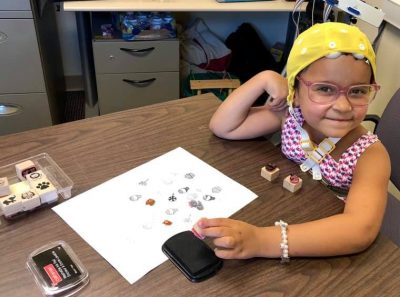
In the CAP Lab at UConn Waterbury, we study the building blocks of early cognitive development. We play different games to understand how kids learn, remember, and think at different points during development. Our “social brain” games involve copying others, while our “cognitive control” games challenge children to do/say the opposite of a natural tendency. By wearing our EEG & ECG sensors as they play, we gain insight into how brain waves and heart activity are involved in kids’ thinking.
Our primary research interests fall into three main themes:
(1) Experimental investigation of early learning and memory
(2) Longitudinal and individual difference analysis of emerging executive functions
(3) Neuroscience foundations of socio-cognitive development
iLearn Study
The iLearn Study is a multi-site research project funded by the NIH and conducted at UConn and the University of Kansas. The study explores how learning and memory develop in infancy — and whether early learning is connected to a child’s thinking, language, and motor skills at age 2.
The MEMORY Study
In this research study, we use play-based tasks to see what toddlers remember and whether small changes in the play experience can strengthen their memory. Children participate in a two-room hiding game and we look at their memory for the what, when, and where details of their experiences!

Bubbles
An NIH multi-site study at UConn & Virginia Tech examining how babies and children regulate their attention, memory, and emotions and how this relates to their heart and brain activity.
Past Research
Husky See, Husky Do Studies
- Ages: 6 weeks to 6 years
- Aims: “How does our social brains develop?” We play imitation, looking, and reaching games with babies and children to study the developing social brain.
Funding:
- NIH R03 HD081333 (K. Cuevas PI) EEG Mu Rhythm Analysis of Infant Social Information Processing
- UConn Waterbury Innovation Grant for Life Transformative Education (K. Cuevas PI)
- UConn Research Excellence Program (K. Cuevas PI)
- UConn Large Faculty Grant (K. Cuevas PI)
- Social Sciences, Humanities, & Arts Research Experience Award (S. Limaye & D. Liyanage)
- Sam L. Witryol Scholarship (L. Bryant)
- UConn Office of Undergraduate Research Supply Award (Y. Lopez & K. Valerio)
- UConn Psychology Department Undergraduate Research Grant (A. Mohiuddin, R. Martinez, C. Flores, S. Limaye, D. Liyanage, S. Moncayo, Y. Lopez, & K. Valerio)
- UConn Summer Undergraduate Research Fund Award (K. Valerio)
This study was approved by the UConn IRB, Protocols #H12-289 and #H14-030.
Completed Projects
Motivation & Preschoolers’ Cognitive Control
Executive functions include a variety of higher order thinking skills, such a inhibitory and cognitive control. For her dissertation, Lauren Bryant examined whether positive effects of incentives on preschoolers’ executive functions were related to individual differences in temperament.
- Kids played opposite games (saying “night” to a sun card) and earned stickers each time they were correct.
- Lauren found that the influence of reward on cognitive control was moderated by children’s reward sensitivity; preschoolers with low reward sensitivity showed the greatest positive impacts of incentives on cognitive control.
- Lauren identified a previously unrecognized developmental shift in links between temperament and cognition-motivation integration—as high reward sensitivity is linked with incentive-enhanced EF during adolescence and adulthood.
- Bryant, L. J., & Cuevas, K. (2022). The effects of reward on children’s Stroop performance: Interactions with temperament. Child Development, 93, e17-e31. https://doi.org/10.1111/cdev.13671
- Want to see the entire research paper for free? Just ask us for a copy!
The Social Brain & Tool-Use in 3- to 6-Year-olds
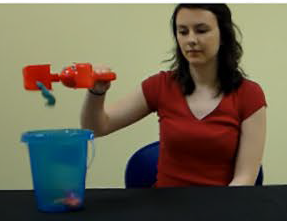
For her master’s thesis, Lauren Bryant was interested in how “hands on” experience differs from passive experience when young children learn new things.
- Kids were shown two new toy tools; they practiced with one and watched a video of someone using the other.
- Lauren found that children showed different patterns of brain waves, which could underlie changes in attention.
- Bryant, L. J., & Cuevas, K. (2019). Effects of active and observational experience on EEG activity during early childhood. Psychophysiology, 56, e13360. https://doi.org/10.1111/psyp.13360
- Want to see the entire research paper for free? Just ask us for a copy!